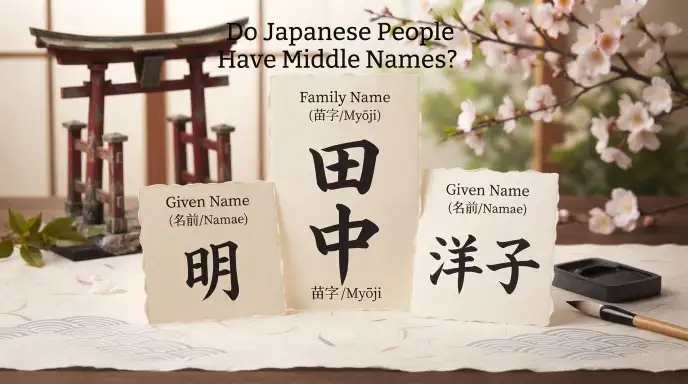
Generally, Japanese people do not have middle names in the traditional Japanese naming system. A typical Japanese name has two main parts: a family name and a given name.
For example, a name such as Sato Haruki has Sato as the family name and Haruki as the given name. In Japanese contexts, the family name is traditionally placed before the given name.
Middle names are more common in countries that use a three part naming pattern. In Japan, however, an extra personal name is not normally part of the traditional naming structure.
How Japanese Names Are Structured
A standard Japanese name usually consists of:
| Part | Example | Role |
| Family name | Sato | Family or surname |
| Given name | Haruki | Personal name |
The family name comes first in Japanese language contexts. The given name follows it.
For example:
Sato Haruki
- Sato = family name
- Haruki = given name
When Japanese names are written or presented in some international settings, the order may sometimes be changed to match local naming conventions.
Do Japanese Names Usually Have Middle Names?
No, a middle name is not normally part of a traditional Japanese name. Most Japanese citizens have a family name and a given name rather than a first name, middle name, and last name.
This means that a Japanese person’s legal name can often look shorter than names commonly used in countries where middle names are standard.
However, individual circumstances can differ. People with international family backgrounds or connections to another country’s naming system may have additional names or naming arrangements.
Why Don’t Japanese People Usually Have Middle Names?
The Japanese naming system developed around the use of a family name and given name, rather than the Western three name structure.
The family name identifies the person’s family, while the given name identifies the individual. Because a separate middle name position is not a standard part of this system, most traditional Japanese names do not include one.
This does not mean that every person of Japanese background must have exactly the same naming arrangement. Legal names can vary depending on nationality, family background, and the countries involved.
Japanese Family Names and Given Names
Japanese names traditionally use a family name followed by a given name. The family name comes first in Japanese language contexts.
For example:
Tanaka Yuki
- Tanaka = family name
- Yuki = given name
When Japanese names are presented in English language settings, the order may sometimes be changed to Yuki Tanaka to match local conventions. However, this does not mean that Yuki is a middle name. It remains the person’s given name.
Japanese Names in Official Documents
Official documents can sometimes make the naming system look different because forms are designed for people from many countries.
Some forms may include separate fields for last name, middle name, and first name. This allows people with different naming systems to enter their names correctly.
The presence of a middle name field does not mean that middle names are a normal part of traditional Japanese naming. Most traditional Japanese names still consist of a family name and a given name.
What About Japanese People With International Backgrounds?
Some people connected to Japan through international families, multiple nationalities, or foreign legal systems may have names that do not follow the typical two part Japanese pattern.
For example, a person with one Japanese parent and one foreign parent may have a name influenced by both naming traditions. Someone who has lived or been legally registered in another country may also have a name that includes an additional part.
Therefore, saying that Japanese people never have middle names would be too broad. A more accurate explanation is that middle names are not a standard feature of traditional Japanese naming.
How Japanese Names Differ From Western Names
The main difference is the structure.
Common Western style structure:
Given name + Middle name + Family name
Example:
Emma Rose Smith
Traditional Japanese structure:
Family name + Given name
Example:
Tanaka Yuki
The traditional Japanese structure does not normally include a separate middle name position. This is why a Japanese name with two parts should not automatically be interpreted as a first name and last name in the same way as a Western name.
Japanese Naming Order
In Japanese, the usual naming order is family name first and given name second. This order is common in Japanese writing and everyday formal contexts.
For example:
Yamada Kenji
Here, Yamada is the family name and Kenji is the given name.
When Japanese names are written in English, you may also see the name as Kenji Yamada. This follows the naming order commonly used in English speaking countries, but it does not add a middle name.
Are Middle Names Used in Japan?
Middle names are not normally used in Japan as part of the traditional naming system. Most Japanese names have two main parts: a family name and a given name.
A person might therefore have a name such as:
- Suzuki Hana
- Kobayashi Ren
- Nakamura Aoi
- Takahashi Kenta
In each example, the first part is the family name and the second part is the given name.
Can a Japanese Person Have a Middle Name?
Yes, although it is not typical of traditional Japanese naming.
A person may have an additional name because of their international family background, foreign nationality, or legal registration in another country. Naming practices can become more complicated when different countries’ legal systems and naming traditions are involved.
For this reason, it is better to say that Japanese people generally do not have middle names, rather than saying that a Japanese person can never have one.
Japanese Names and International Forms
People using Japanese names outside Japan may encounter forms that ask for:
- First name
- Middle name
- Last name
A Japanese person who does not have a middle name may simply have no middle name entry. The exact way a name is entered can depend on the form, country, passport, or other official document.
This is one reason Japanese names can sometimes look different when they appear on international documents.
What Is the Difference Between a Given Name and a Middle Name?
A given name is the personal name given to an individual. A middle name is an additional name that appears between the given name and family name in naming systems that use one.
For example:
Western style: Emma Rose Smith
- Emma = given name
- Rose = middle name
- Smith = family name
Japanese style: Tanaka Yuki
- Tanaka = family name
- Yuki = given name
So, when a Japanese name has two parts, the second part is normally the given name, not a middle name.
Japanese Names in Different Countries
Japanese names can appear differently when a person lives outside Japan. In many English speaking countries, names are usually written with the given name first and family name second, so a Japanese name may be rearranged.
For example:
Japanese order: Tanaka Yuki
International order: Yuki Tanaka
Changing the order does not create a middle name. The person still has a family name and a given name.
Japanese People With Foreign Names
Some Japanese people may have a foreign name in addition to a Japanese name because of their family background or connection to another country.
For example, a person with parents from different cultural backgrounds may have a naming structure influenced by both countries. Their legal name may therefore contain more parts than a traditional Japanese name.
This is one reason it is important to look at a person’s actual legal or cultural naming system rather than assuming that every name follows exactly the same pattern.
Do Japanese Children Get Middle Names?
In the traditional Japanese naming system, children generally receive a family name and a given name, not a separate middle name.
For example:
Family name: Saito
Given name: Mei
The child would normally be known as Saito Mei in Japanese naming order.
If the child’s family has international connections, however, their legal naming arrangement may be different.
Do Japanese Names Have Three Parts?
A traditional Japanese personal name usually does not follow the three part structure common in countries where middle names are widespread.
A simple comparison is:
Three part Western style name:
Emma Rose Carter
Traditional Japanese name:
Sato Haruka
In the first example, Rose is a middle name. In the Japanese example, Haruka is the given name, not a middle name.
Quick Answer: Do Japanese People Have Middle Names?
Usually, no. Traditional Japanese names generally consist of a family name and a given name, with the family name normally written first.
However, some people may have additional names because of international family backgrounds, nationality, or foreign legal naming systems. So, middle names are possible in individual cases, but they are not a standard part of traditional Japanese naming.
Japanese Names and Marriage
Marriage can sometimes affect how a person’s name is used or registered, but it does not normally create a middle name. In the traditional Japanese naming system, a married person generally has a family name and a given name.
For example:
Family Name: Suzuki
Given Name: Yuna
If a person changes their family name after marriage, the family name part may change, while the given name stays the same.
Japanese Children With International Parents
Children with parents from different countries may have naming arrangements that differ from the traditional Japanese pattern. Their names can reflect the naming customs of both sides of the family.
For example, a child may have a Japanese family name and a foreign given name, or a name that follows another country’s naming convention.
This means that a name with three parts does not automatically mean that one part is a traditional Japanese middle name. The person’s nationality, family background, and legal registration can all matter.
How to Tell if a Japanese Name Has a Middle Name
The number of words in a name is not always enough to identify a middle name.
Consider:
Tanaka Haru
This has two parts:
- Tanaka = family name
- Haru = given name
If a name has additional parts, the person’s official records or naming background may be needed to understand what each part represents.
This is especially important for Japanese people who have connections to countries where middle names are commonly used.
Are Middle Names Required in Japan?
No. A middle name is not a standard requirement of the traditional Japanese naming system.
Japanese names generally use a family name and a given name. Forms created for international use may include a middle name field, but that does not mean every person is expected to have a middle name.
What Should You Know About Japanese Middle Names?
The main points are simple:
- Traditional Japanese names usually have two main parts.
- The family name normally comes first in Japanese.
- The given name comes after the family name.
- A separate middle name is not a standard part of Japanese naming.
- Some people may have additional names because of international or legal circumstances.
- A Japanese name with more than two parts should not automatically be assumed to follow the traditional Japanese system.
Japanese Names in Everyday Life
In everyday Japanese life, people normally use their family name and given name rather than a middle name. In formal situations, the family name is often used when addressing someone, especially with an appropriate title.
For example, someone named Sato Aiko may commonly be addressed as Sato san. The name Aiko is the person’s given name, not a middle name.
Do Japanese Students Have Middle Names?
Japanese students generally do not have middle names as part of the traditional naming system. School records and everyday introductions normally use the student’s family name and given name.
For example:
Family Name: Nakamura
Given Name: Ren
The student may be known as Nakamura Ren in Japanese contexts.
Students with international family backgrounds may have different legal names, so individual situations can vary.
Japanese Names in Business and Formal Settings
Japanese naming conventions are also visible in workplaces and other formal settings. Family names are commonly important when introducing or addressing people.
For example:
Yamada Ken
Here, Yamada is the family name and Ken is the given name.
A middle name is not normally inserted between these two parts. When the name is written in a Western order as Ken Yamada, the structure has still not changed; only the order has changed.
Can Japanese Names Be Long?
Yes. Japanese names can sometimes look longer because of the number of characters used to write them, especially when written in Japanese scripts.
However, the length of a name does not mean that it contains a middle name. A traditional name can still consist of only a family name and a given name.
For example:
Kobayashi Haruka
Even though the name may look different when written in Japanese characters, Kobayashi remains the family name and Haruka remains the given name.
Do Japanese People Use Nicknames Instead of Middle Names?
Nicknames can be used in Japan, but they are not middle names. Friends, classmates, family members, or colleagues may use shortened names, affectionate forms, or other nicknames.
For example, someone named Yuki might have a personal nickname used by friends. That nickname does not become an official middle name.
This distinction is useful because a person can have a nickname without having a middle name at all.
Japanese Names on Passports and International Documents
Japanese names can sometimes look different on passports, applications, or other international documents because these documents may be designed around naming systems used in many countries.
A form may ask for first name, middle name, and last name, even when a Japanese person has no middle name. In that situation, the person generally follows the instructions provided by the relevant authority rather than creating a middle name.
Why Name Order Can Cause Confusion
Name order is one of the biggest reasons Japanese names can be misunderstood outside Japan.
For example:
Sato Yuki
In traditional Japanese order:
- Sato = family name
- Yuki = given name
In an English language setting, it may appear as:
Yuki Sato
The order has changed, but the person’s name has not gained a middle name.
Japanese Names and Western Naming Systems
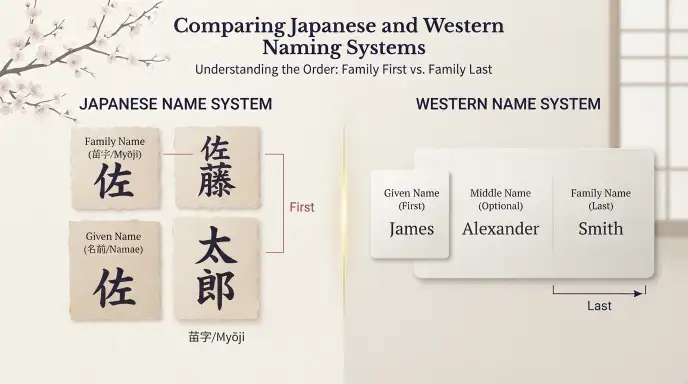
Western naming systems often use a structure such as:
Given Name + Middle Name + Family Name
Japanese naming traditionally follows:
Family Name + Given Name
Because of this difference, a Japanese person completing an international form may need to carefully follow the form’s instructions.
A two part Japanese name should not automatically be divided into first name and middle name simply because the form uses Western naming conventions.
Can a Japanese Person Choose a Middle Name?
A person may use an additional name in certain international or personal circumstances, but this should not be confused with the traditional Japanese naming system.
If someone has a foreign nationality, international family background, or legal name connected to another country’s naming system, their name may contain additional elements.
For a person with an ordinary traditional Japanese name, however, a separate middle name is not normally part of the name.
What Is the Simple Answer?
If you are wondering “Do Japanese people have middle names?”, the simplest answer is:
Usually, Japanese people do not have middle names.
Traditional Japanese names generally contain a family name and a given name, with the family name normally appearing first in Japanese.
Individual cases can differ because of international families, nationality, marriage, and foreign legal systems. This is why “usually no” is more accurate than saying “never.”
Common Questions About Japanese Middle Names
Understanding Japanese naming conventions can be easier when you look at the most common questions people ask about middle names, family names, and given names.
Do Japanese people traditionally have middle names?
No. Traditional Japanese names generally consist of a family name and a given name. A separate middle name is not normally included.
Is the first name or last name written first in Japan?
In Japanese naming order, the family name is generally written first, followed by the given name.
Can a Japanese person have a middle name?
Yes, individual cases can differ. People with international family backgrounds, foreign nationality, or connections to another country’s legal naming system may have additional names.
Do Japanese children have middle names?
Children in traditional Japanese families generally have a family name and a given name rather than a separate middle name.
Why do some Japanese names have more than two parts?
Additional name elements can occur because of international family backgrounds, nationality, or foreign naming and legal systems. The extra part should not automatically be assumed to be a traditional Japanese middle name.
Does changing the name order create a middle name?
No. Sato Yuki and Yuki Sato can represent the same family name and given name in different naming orders. Changing the order does not create a middle name.
FAQ: Do Japanese People Have Middle Names?
Do Japanese people have middle names?
Most Japanese people do not have middle names. Traditional Japanese names generally consist of a family name and a given name.
What is the Japanese naming order?
The traditional order is family name first, followed by the given name. For example, in “Tanaka Yuki,” Tanaka is the family name and Yuki is the given name.
Are middle names common in Japan?
No. Middle names are not a standard feature of the traditional Japanese naming system.
Can someone in Japan have a middle name?
Individual cases can differ. A person with international family connections, another nationality, or a foreign legal name may have additional names.
Do Japanese passports include middle names?
A Japanese passport does not require every person to have a middle name. If a person’s legal name contains additional name elements because of their particular circumstances, the way those elements appear can depend on the applicable official records and passport rules.
Are Japanese given names the same as middle names?
No. A Japanese given name is the person’s main personal name. It should not be considered a middle name simply because it appears after the family name.
Why do Japanese names sometimes appear in a different order?
When Japanese names are used internationally, they may be written in the order commonly used in that country. For example, Tanaka Yuki may appear as Yuki Tanaka. The name itself has not gained a middle name.
Is it wrong to say Japanese people never have middle names?
Yes, that would be too absolute. The more accurate statement is that middle names are not normally part of traditional Japanese naming, although individual people can have different naming arrangements.
Conclusion
Japanese people generally do not have middle names in the traditional naming system. A typical Japanese name contains a family name and a given name, with the family name usually written first in Japanese.
However, international families, multiple nationalities, and foreign legal systems can create individual exceptions. Therefore, the best simple answer is usually no, but some individual cases may be different.
Discover more names!

Hi, I’m Emily Broks, a name researcher and content writer. I enjoy exploring unique baby names, meaningful names, pet names, cultural names, and creative name ideas to help readers find the perfect name.