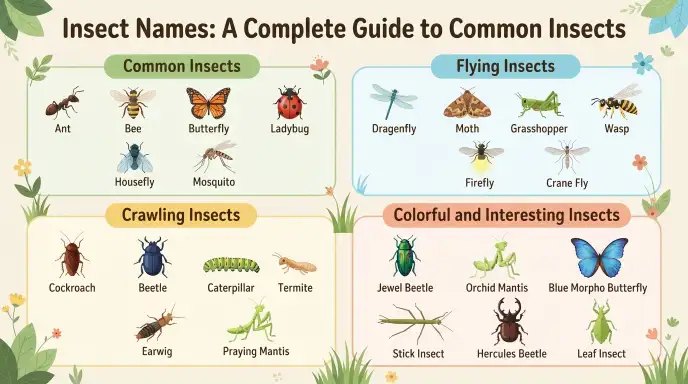
Insect names help us identify the small creatures we see in gardens, homes, forests, and other natural places. Some insects, such as butterflies and bees, are easy to recognize, while others, such as lacewings and weevils, are less familiar.
Insects come in many shapes, sizes, and colors. Some pollinate flowers, others feed on pests, and many provide food for birds and other animals. Certain species can also damage crops, infest homes, or spread diseases.
This guide covers common insect names, flying insects, crawling insects, garden insects, household insects, and unusual species. It also explains how to identify insects and understand the differences between insects and other small creatures.
List of Common Insect Names
Here are 30 common insect names with a simple description of each.
| No. | Insect Name | Common Feature |
| 1 | Ant | Lives in colonies |
| 2 | Bee | Many species pollinate flowers |
| 3 | Butterfly | Often has colorful wings |
| 4 | Moth | Many species are active at night |
| 5 | Beetle | Usually has hardened front wings |
| 6 | Housefly | Common around human settlements |
| 7 | Mosquito | Some species spread diseases |
| 8 | Grasshopper | Has strong hind legs for jumping |
| 9 | Cricket | Many species produce chirping sounds |
| 10 | Dragonfly | A fast flying predator |
| 11 | Termite | Many species feed on plant material |
| 12 | Praying mantis | Uses its front legs to catch prey |
| 13 | Ladybug | Many species eat plant pests |
| 14 | Cockroach | Often hides in sheltered places |
| 15 | Wasp | Many species hunt other insects |
| 16 | Firefly | Some species produce light |
| 17 | Flea | A small insect that can jump |
| 18 | Louse | Lives on a host |
| 19 | Aphid | Feeds on plant sap |
| 20 | Stick insect | Often resembles a twig |
| 21 | Earwig | Has pincers at the end of its abdomen |
| 22 | Silverfish | Has a tapered, silvery body |
| 23 | Weevil | Often has an elongated snout |
| 24 | Lacewing | Has delicate, net like wings |
| 25 | Cicada | Many species produce loud calls |
| 26 | Leafhopper | Often jumps between plants |
| 27 | Fruit fly | Common around ripe or fermenting fruit |
| 28 | Gnat | Usually small and delicate |
| 29 | Bed bug | Feeds on blood |
| 30 | Mayfly | Has a short lived adult stage |
These insects belong to different groups and live in a variety of habitats. Their body shapes, feeding habits, and behaviors help us recognize them.
Names of Flying Insects
Flying insects use their wings to find food, escape predators, and move between habitats. Some fly regularly, while others develop wings only during certain stages of life.
Here are 25 flying insect names:
- Butterfly
- Moth
- Honeybee
- Bumblebee
- Dragonfly
- Damselfly
- Housefly
- Mosquito
- Fruit fly
- Gnat
- Wasp
- Hornet
- Firefly
- Lacewing
- Mayfly
- Caddisfly
- Crane fly
- Cicada
- Hoverfly
- Robber fly
- Blowfly
- Deer fly
- Horsefly
- Sawfly
- Flying termite
Not all flying insects have the same wing structure. Beetles have hardened front wings that protect their flight wings, while true flies have one pair of functional wings and a modified hind pair that helps them maintain balance.
Names of Crawling Insects
Crawling insects move across soil, leaves, tree bark, walls, and other surfaces. Some also climb, jump, or fly.
Common crawling insect names include:
- Ant
- Cockroach
- Ground beetle
- Weevil
- Earwig
- Silverfish
- Firebrat
- Flea
- Louse
- Bed bug
- Termite
- Praying mantis
- Stick insect
- Leaf insect
- Darkling beetle
- Mole cricket
- Thrips
- Aphid
- Booklouse
- Carpet beetle
These insects have different body shapes and feeding habits. Some search for food on the ground, while others live on plants, inside buildings, or beneath rocks and fallen leaves.
Names of Garden Insects
Gardens attract insects because they provide flowers, leaves, shelter, and food. Some insects support plant growth by pollinating flowers or eating pests. Others damage leaves, stems, roots, and fruits.
| No. | Insect Name | Role in the Garden |
| 1 | Honeybee | Pollinates flowering plants |
| 2 | Bumblebee | Pollinates flowers and crops |
| 3 | Ladybug | Many species eat aphids |
| 4 | Green lacewing | Larvae often eat small pests |
| 5 | Hoverfly | Adults visit flowers; many larvae eat aphids |
| 6 | Aphid | Feeds on plant sap |
| 7 | Caterpillar | Many species feed on leaves |
| 8 | Leafhopper | Sucks sap from plants |
| 9 | Mealybug | Feeds on plant sap |
| 10 | Scale insect | Attaches to plants and feeds on sap |
| 11 | Stink bug | Some species damage crops |
| 12 | Grasshopper | Many species eat leaves and grasses |
| 13 | Praying mantis | Hunts other insects |
| 14 | Ground beetle | Many species prey on small animals |
| 15 | Weevil | Some species damage roots and crops |
An insect’s effect depends on its species and population. Some beetles help control garden pests, while others damage plants or stored seeds.
Names of Insects Found in Homes
Household insects may enter buildings to find food, moisture, warmth, or shelter. Some live around stored food, wooden structures, fabrics, and indoor plants.
Here are 20 common household insect names:
- Housefly
- Fruit fly
- Ant
- Cockroach
- Mosquito
- Clothes moth
- Carpet beetle
- Bed bug
- Silverfish
- Booklouse
- Drain fly
- Flour beetle
- Pantry beetle
- Flea
- Termite
- Paper wasp
- House cricket
- Indian meal moth
- Fungus gnat
- House centipede
A house centipede is not an insect. It belongs to a different group of arthropods and has many more than six legs. People often include it in household pest lists because it commonly appears indoors.
Correct identification helps you understand where a pest lives and how to manage it appropriately.
Names of Insects That Live in Water
Some insects spend their early lives in water, while others live on the water’s surface or hunt beneath it. Many aquatic insects eventually emerge as winged adults.
| No. | Insect Name | Habitat or Feature |
| 1 | Water strider | Moves across the water surface |
| 2 | Diving beetle | Swims underwater |
| 3 | Whirligig beetle | Often circles on the water surface |
| 4 | Backswimmer | Swims on its back |
| 5 | Water boatman | Often feeds on algae or small organisms |
| 6 | Giant water bug | Aquatic predator |
| 7 | Dragonfly nymph | Develops underwater |
| 8 | Damselfly nymph | Lives in freshwater |
| 9 | Mayfly nymph | Often lives in streams |
| 10 | Caddisfly larva | Common in freshwater habitats |
| 11 | Mosquito larva | Develops in water |
| 12 | Stonefly nymph | Often found in flowing water |
Water associated insects have adaptations that help them survive in their environments. Some swim actively, while others remain underwater until they reach adulthood.
Names of Unusual and Interesting Insects
Some insects stand out because of their unusual shapes, colors, sizes, or survival strategies. These names are useful for nature studies, school projects, and general knowledge.
- Orchid mantis
- Thorn bug
- Jewel beetle
- Giraffe weevil
- Leaf insect
- Walking stick insect
- Glasswing butterfly
- Atlas moth
- Hercules beetle
- Elephant hawk moth
- Devil’s flower mantis
- Spiny flower mantis
- Bombardier beetle
- Death’s head hawkmoth
- Giant weta
- Lanternfly
- Tiger beetle
- Longhorn beetle
- Goliath beetle
- Titan beetle
- Peacock butterfly
- Orchid bee
- Giant walking stick
- Giant water bug
- Peanut headed bug
Common insect names can differ between regions. Some describe an insect’s appearance, while others refer to its behavior or habitat.
Names of Small Insects
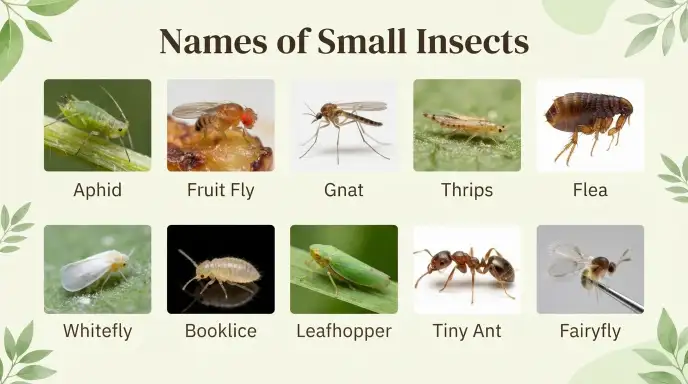
Small insects can be difficult to see without close inspection. Many live on plants, in soil, around stored food, or in damp places.
Examples of small insect names include:
- Aphid
- Thrips
- Booklouse
- Fungus gnat
- Fruit fly
- Flea
- Whitefly
- Mealybug
- Scale insect
- Minute pirate bug
- Leafhopper
- Planthopper
- Barklouse
- Featherwing beetle
- Tiny parasitoid wasp
- Midge
- Mosquito
- Small ant
- Green lacewing
- Fairyfly
Some of the smallest insects require magnification for accurate identification. Fairyflies, for example, are tiny parasitoid wasps that develop inside the eggs of other insects.
Names of Large Insects
Large insects are known for their body length, weight, or wingspan. Different species hold different size records, so the largest insect depends on how scientists measure it.
Some well known examples include:
- Goliath beetle
- Hercules beetle
- Titan beetle
- Atlas moth
- Queen Alexandra’s birdwing
- Giant weta
- Giant walking stick
- Giant water bug
- Elephant beetle
- Giant burrowing cockroach
- Giant dobsonfly
- Atlas beetle
- Giant silk moth
- Giant longhorn beetle
- Giant grasshopper
Some beetles have exceptionally heavy bodies, while certain butterflies and moths have very large wingspans. Long bodied stick insects can also reach impressive lengths.
Beneficial and Harmful Insect Names
Insects support ecosystems in many ways, but some species also cause problems for people, animals, and crops.
| Beneficial Insects | Insects That Can Cause Problems |
| Honeybee | Mosquito |
| Bumblebee | Bed bug |
| Ladybug | Flea |
| Green lacewing | Crop damaging aphid |
| Hoverfly | Structural termite pest |
| Ground beetle | Certain crop pests |
| Dung beetle | Clothes moth |
| Pollinating butterfly | Leaf eating caterpillar |
| Parasitoid wasp | Stored food beetle pest |
| Decomposer beetle | Cockroach in unsanitary conditions |
These categories are not absolute. A species may provide ecological benefits while also causing problems in a particular setting. Many wasps, for example, help control other insects, even though some can sting.
How to Identify an Insect
You can often identify an insect by examining its body shape, legs, antennae, wings, color, and habitat.
Follow these basic steps:
- Count the legs. Adult insects have six legs.
- Examine the body. An insect has three main body regions: head, thorax, and abdomen.
- Look at the antennae. Insects have one pair of antennae.
- Check the wings. Many adult insects have wings, but some have none.
- Observe the habitat. The location can help narrow down the possible insect group.
- Notice its behavior. Jumping, crawling, swimming, or visiting flowers may provide useful clues.
Not every insect has wings, and some immature insects look very different from adults. For accurate identification, compare several features instead of relying on color or size alone.
What Is the Difference Between Insects and Bugs?
People often use the word bug to describe almost any small creature. In scientific classification, however, true bugs belong to a specific group of insects.
- Insects: Arthropods with six legs and three main body regions.
- True bugs: Insects in the order Hemiptera, including bed bugs, stink bugs, and water striders.
- Spiders: Arachnids with eight legs.
- Centipedes: Arthropods with many legs.
- Ticks: Arachnids related to mites and spiders.
True bugs have specialized mouthparts that allow them to feed on fluids from plants or animals. Understanding this distinction helps you identify insects more accurately.
Frequently Asked Questions About Insect Names
1. What are the 10 most common insect names?
Ten familiar insect names are ants, bees, butterflies, moths, beetles, houseflies, mosquitoes, grasshoppers, crickets, and dragonflies. Their abundance varies by location, climate, and season.
2. What are the names of flying insects?
Flying insects include butterflies, moths, bees, wasps, flies, mosquitoes, dragonflies, damselflies, lacewings, and fireflies. Some insects develop wings only during particular stages of their lives.
3. Which insects are commonly found in gardens?
Common garden insects include ladybugs, bees, aphids, hoverflies, lacewings, grasshoppers, caterpillars, and leafhoppers. Some help plants, while others feed on leaves or sap.
4. Is a spider an insect?
No. A spider is an arachnid. Adult spiders have eight legs, while insects have six.
5. Which insects are beneficial?
Honeybees, bumblebees, ladybugs, lacewings, hoverflies, and many ground beetles provide useful ecological services. They may pollinate plants, eat pests, or help break down organic material.
6. What are some of the smallest insects?
Some of the smallest known insects are tiny parasitoid wasps, including fairyflies. Their size varies by species, and many are difficult to see without magnification.
7. What are some of the largest insects?
Examples include Goliath beetles, titan beetles, giant walking sticks, Atlas moths, and Queen Alexandra’s birdwing butterflies. The answer depends on if you compare body length, body mass, or wingspan.
8. How many insect species are there?
Scientists have described more than one million insect species, but the total number of existing species remains uncertain. Many insects have not yet been discovered or formally described.
9. Are all insects harmful?
No. Many insects pollinate plants, control pests, decompose organic material, and provide food for other animals. Some species damage crops, infest homes, or transmit diseases.
10. How can I learn insect names easily?
Start with familiar insects such as ants, bees, butterflies, beetles, flies, and grasshoppers. Then compare their body shapes, legs, wings, colors, and habitats. Nature guides and educational resources can help you identify less familiar species.
Final Thoughts
Learning insect names helps us understand the variety of life around us. From colorful butterflies and busy honeybees to crawling beetles and aquatic dragonfly nymphs, each insect group has distinct features and a role in nature.
A useful insect list should do more than provide names. It should help readers recognize different insects, understand where they live, and distinguish helpful species from those that may cause problems. By learning their basic characteristics and observing them carefully, you can build your knowledge of the natural world one species at a time.
Insect names help us identify the small creatures we see in gardens, homes, forests, and other natural places. Some insects, such as butterflies and bees, are easy to recognize, while others, such as lacewings and weevils, are less familiar.
Insects come in many shapes, sizes, and colors. Some pollinate flowers, others feed on pests, and many provide food for birds and other animals. Certain species can also damage crops, infest homes, or spread diseases.
This guide covers common insect names, flying insects, crawling insects, garden insects, household insects, and unusual species. It also explains how to identify insects and understand the differences between insects and other small creatures.
Explore more names!

Hi, I’m Emily Broks, a name researcher and content writer. I enjoy exploring unique baby names, meaningful names, pet names, cultural names, and creative name ideas to help readers find the perfect name.