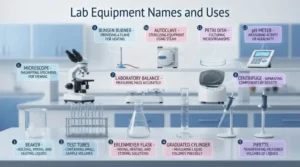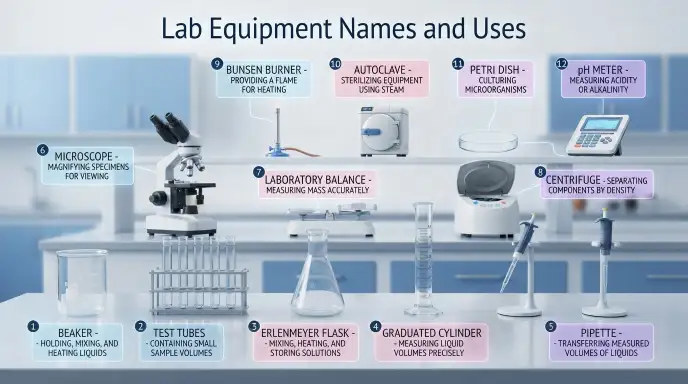
Laboratories use many tools to measure, heat, mix, observe, separate, and store materials. Each piece of equipment has a specific job, and knowing its purpose helps students and beginners understand how laboratory work happens.
Some lab equipment is simple, such as beakers, test tubes, funnels, and glass rods. Other tools, such as microscopes, centrifuges, autoclaves, and spectrophotometers, perform more specialized tasks. The equipment used in a laboratory depends on the type of work being done.
This guide explains lab equipment names and uses in simple terms. It covers basic glassware, measuring tools, heating equipment, laboratory instruments, safety equipment, and tools used in biology, chemistry, and medical laboratories.
What Is Laboratory Equipment?
Laboratory equipment includes the tools, instruments, containers, machines, and safety items used for scientific work. Scientists and students use these items to handle samples, measure substances, perform experiments, observe specimens, and analyze results.
A chemistry laboratory may need different equipment from a biology or medical laboratory. For example, a biology lab may use microscopes and Petri dishes, while a chemistry lab may use burettes, balances, and fume hoods.
Common Lab Equipment Names and Uses
| Lab Equipment | Main Use |
| Beaker | Holding, mixing, and heating liquids |
| Test Tube | Holding and mixing small samples |
| Erlenmeyer Flask | Mixing and holding liquids |
| Graduated Cylinder | Measuring liquid volume |
| Pipette | Transferring measured liquids |
| Burette | Delivering precise liquid volumes |
| Funnel | Pouring or filtering liquids |
| Microscope | Viewing very small objects |
| Thermometer | Measuring temperature |
| Balance | Measuring mass |
| Bunsen Burner | Heating materials |
| Hot Plate | Heating samples without an open flame |
| Centrifuge | Separating sample components |
| Autoclave | Sterilizing suitable materials with steam |
| Incubator | Maintaining controlled conditions for samples |
| pH Meter | Measuring acidity or alkalinity |
| Spectrophotometer | Measuring light absorption by samples |
| Fume Hood | Controlling exposure to hazardous chemical vapors |
| Petri Dish | Holding samples and growing cultures |
| Mortar and Pestle | Grinding solid materials |
1. Beaker
A beaker is one of the most common pieces of laboratory glassware. It has a wide opening and usually includes markings for approximate volume.
Uses of a Beaker
- Holding liquids
- Mixing solutions
- Heating materials
- Pouring liquids
- Preparing simple solutions
Beaker markings are generally not intended for highly accurate volume measurement, so laboratories use more precise equipment when exact volume matters.
2. Test Tube
A test tube is a small cylindrical container with an open top. It holds small amounts of liquids or other samples.
Uses of a Test Tube
- Holding samples
- Mixing small quantities of chemicals
- Performing small reactions
- Heating suitable samples
- Observing changes in a sample
A test tube rack keeps test tubes upright and organized.
3. Erlenmeyer Flask
An Erlenmeyer flask has a wide bottom and a narrow neck. Its shape makes it useful for mixing liquids with less risk of spilling.
Uses of an Erlenmeyer Flask
- Mixing solutions
- Holding liquids
- Preparing samples
- Heating suitable solutions
- Swirling liquids
Its narrow opening also helps reduce splashing during mixing.
4. Graduated Cylinder
A graduated cylinder is designed to measure liquid volume more accurately than a typical beaker.
Uses of a Graduated Cylinder
- Measuring liquids
- Preparing solutions
- Comparing liquid volumes
- Transferring measured amounts
Different sizes are available for different volume ranges.
5. Pipette
A pipette transfers a measured amount of liquid from one container to another.
Uses of a Pipette
- Transferring liquids
- Measuring small volumes
- Preparing solutions
- Adding controlled amounts of reagents
Different pipettes provide different levels of precision and volume ranges.
6. Burette
A burette is a long graduated tube with a control valve at the bottom. It allows a user to deliver liquid in a controlled way.
Uses of a Burette
- Titration
- Delivering precise liquid volumes
- Measuring how much solution reacts with another solution
Burettes are especially common in analytical chemistry.
7. Funnel
A laboratory funnel helps transfer liquids into containers with narrow openings. Some funnels also support filtration.
Uses of a Funnel
- Pouring liquids
- Filtering mixtures
- Transferring powders
- Preventing spills during transfer
Different laboratory funnels serve different purposes.
8. Microscope
A microscope magnifies objects that are too small to see clearly with the unaided eye.
Uses of a Microscope
- Observing cells
- Studying microorganisms
- Examining tissue samples
- Viewing small structures
- Supporting biological research
Microscopes come in different types, including light and electron microscopes.
9. Thermometer
A thermometer measures temperature.
Uses of a Thermometer
- Checking sample temperature
- Monitoring experiments
- Measuring heating and cooling
- Controlling laboratory processes
Modern laboratories may use digital thermometers or electronic temperature sensors.
10. Laboratory Balance
A laboratory balance measures the mass of a sample. Different balances provide different levels of precision.
Uses of a Laboratory Balance
- Measuring chemicals
- Weighing samples
- Preparing solutions
- Recording experimental measurements
An analytical balance provides much greater precision than a basic laboratory balance.
11. Bunsen Burner
A Bunsen burner produces a controlled flame for heating suitable laboratory materials.
Uses of a Bunsen Burner
- Heating solutions
- Performing heat based experiments
- Sterilizing certain tools when appropriate
- Producing controlled laboratory flames
Because an open flame can create fire hazards, users should follow laboratory safety procedures.
12. Hot Plate
A hot plate heats containers or samples without using an open flame.
Uses of a Hot Plate
- Heating solutions
- Warming samples
- Maintaining controlled heating
- Heating materials when an open flame is unsuitable
Hot plates are common in chemistry laboratories.
13. Centrifuge
A centrifuge spins samples at high speed to separate components based on differences in density.
Uses of a Centrifuge
- Separating liquids and solids
- Separating components of biological samples
- Preparing samples for analysis
- Concentrating certain materials
Centrifuges require proper balancing and safe operating procedures.
14. Autoclave
An autoclave uses pressurized steam and controlled heat to sterilize suitable laboratory materials.
Uses of an Autoclave
- Sterilizing laboratory equipment
- Processing suitable culture materials
- Sterilizing certain reusable items
- Treating suitable laboratory waste
Autoclaves can create serious heat and pressure hazards, so trained users should follow the equipment’s operating instructions.
15. Incubator
An incubator provides controlled environmental conditions, often including temperature, for samples or cultures.
Uses of an Incubator
- Supporting microbial cultures
- Maintaining samples at controlled temperatures
- Supporting biological experiments
- Studying growth under controlled conditions
Different incubators provide different temperature and environmental controls.
16. pH Meter
A pH meter measures how acidic or alkaline a solution is.
Uses of a pH Meter
- Testing solutions
- Checking water quality
- Monitoring chemical reactions
- Measuring biological samples
- Preparing solutions with a target pH
It provides a numerical pH value rather than relying only on color indicators.
17. Spectrophotometer
A spectrophotometer measures how a sample interacts with light. Scientists can use the measurement to study the concentration or properties of certain substances.
Uses of a Spectrophotometer
- Analyzing samples
- Measuring absorbance
- Studying chemical compounds
- Supporting biological tests
- Comparing sample concentrations
It is more specialized than basic laboratory glassware.
18. Fume Hood
A fume hood is a laboratory ventilation device designed to help control exposure to hazardous chemical vapors and other airborne contaminants.
Uses of a Fume Hood
- Handling hazardous chemicals
- Controlling chemical vapors
- Providing a ventilated work area
- Reducing exposure risks
Fume hoods are an important safety feature in laboratories where hazardous chemicals are used.
19. Petri Dish
A Petri dish is a shallow dish commonly used in biological and microbiological work.
Uses of a Petri Dish
- Holding biological samples
- Growing cultures under appropriate conditions
- Observing colonies
- Supporting microbiology experiments
Petri dishes are available in glass and disposable plastic forms.
20. Mortar and Pestle
A mortar and pestle are used together to crush and grind solid materials.
Uses of a Mortar and Pestle
- Grinding solid chemicals
- Crushing plant materials
- Preparing samples
- Mixing small amounts of solid substances
The mortar holds the material while the pestle provides the grinding action.
21. Glass Rod
A glass rod is a simple laboratory tool used mainly for stirring and directing liquids during transfers.
Uses of a Glass Rod
- Stirring solutions
- Helping with liquid transfer
- Supporting simple laboratory procedures
Glass rods are easy to clean and useful for basic laboratory tasks.
22. Dropper
A dropper transfers small amounts of liquid one drop at a time.
Uses of a Dropper
- Adding liquid slowly
- Transferring small amounts
- Adding indicators
- Handling reagents during simple experiments
A dropper does not provide the same measurement accuracy as a precision pipette.
23. Watch Glass
A watch glass is a shallow, curved piece of laboratory glassware.
Uses of a Watch Glass
- Holding small samples
- Covering beakers
- Allowing small amounts of liquid to evaporate
- Supporting simple laboratory procedures
24. Crucible
A crucible is a heat resistant container used for heating materials at high temperatures.
Uses of a Crucible
- Heating solid materials
- Performing high temperature reactions
- Heating samples for specific analytical procedures
Crucibles are usually made from heat resistant materials such as ceramic.
25. Spatula
A laboratory spatula is used to transfer small amounts of solid materials.
Uses of a Spatula
- Moving powdered chemicals
- Transferring solid samples
- Measuring small quantities for laboratory work
- Scraping materials from containers
Lab Equipment Used for Measuring
Accurate measurement is important in laboratory work. Common measuring equipment includes:
- Laboratory balances
- Analytical balances
- Graduated cylinders
- Pipettes
- Burettes
- Thermometers
- pH meters
- Spectrophotometers
Each tool measures a different property or provides a different level of accuracy.
Lab Equipment Used for Heating
Laboratories use several tools to provide controlled heat.
Common heating equipment includes:
- Bunsen burners
- Hot plates
- Heating blocks
- Water baths
- Ovens
- Furnaces
The correct heating method depends on the material, temperature, and procedure.
Lab Equipment Used for Separation
Some laboratory procedures require scientists to separate different parts of a mixture.
Common equipment includes:
- Centrifuges
- Filtration funnels
- Filter systems
- Separatory funnels
- Chromatography equipment
The equipment selected depends on the type of mixture and the desired result.
Lab Equipment Used in Biology
Biology laboratories often use equipment for observing cells, growing cultures, preparing samples, and studying biological materials.
| Equipment | Use |
| Microscope | Viewing cells and small specimens |
| Petri Dish | Holding cultures and samples |
| Incubator | Maintaining controlled growth conditions |
| Centrifuge | Separating sample components |
| Pipette | Transferring measured liquids |
| Test Tube | Holding small samples |
| Autoclave | Sterilizing suitable materials |
| Water Bath | Maintaining controlled sample temperatures |
Lab Equipment Used in Chemistry
Chemistry laboratories often require equipment for measuring, mixing, heating, separating, and analyzing substances.
Common equipment includes:
- Beakers
- Flasks
- Burettes
- Pipettes
- Graduated cylinders
- Balances
- Bunsen burners
- Hot plates
- Fume hoods
- pH meters
- Spectrophotometers
- Funnels
- Crucibles
The exact equipment depends on the experiment and the chemicals involved.
Laboratory Safety Equipment
Safety equipment protects laboratory workers from chemical, biological, physical, and other hazards. Laboratory safety practices should match the risks present in the specific work area.
| Safety Equipment | Purpose |
| Safety Goggles | Protecting the eyes |
| Lab Coat | Protecting clothing and skin |
| Gloves | Protecting hands when appropriate |
| Face Shield | Providing additional face protection |
| Fume Hood | Controlling hazardous vapors |
| Eyewash Station | Providing emergency eye flushing |
| Safety Shower | Emergency body flushing |
| Fire Extinguisher | Responding to suitable small fires |
| Biosafety Cabinet | Providing containment for certain biological work |
Safety equipment does not replace proper training. Users should understand the hazards of the materials and procedures before starting laboratory work.
How to Choose the Right Lab Equipment
Choosing laboratory equipment depends on the task. Consider these factors before selecting a tool:
1. Type of Experiment
First, identify what the experiment requires. A microbiology experiment may need an incubator and microscope, while analytical chemistry may require a balance and spectrophotometer.
2. Required Accuracy
Not every measuring tool provides the same accuracy. Use equipment designed for the level of precision your procedure requires.
3. Sample Size
Choose equipment that suits the amount of material being handled. Small samples may require micropipettes, while larger volumes may require graduated cylinders or larger vessels.
4. Material Compatibility
Check if the equipment is suitable for the chemicals, temperatures, and other conditions involved.
5. Safety Requirements
Consider ventilation, temperature, pressure, biological hazards, chemical exposure, and other risks before using equipment.
Why Knowing Lab Equipment Names and Uses Matters
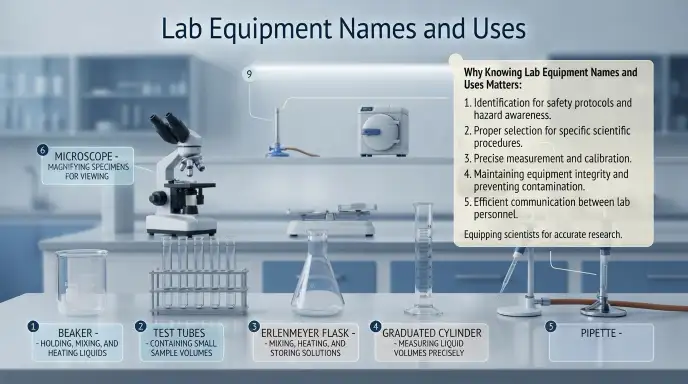
Learning laboratory equipment names makes it easier to understand experiment instructions and identify the correct tool for a task.
It also helps students recognize the difference between equipment that looks similar. For example, a beaker can hold and roughly estimate liquid volume, while a graduated cylinder is designed for more accurate volume measurement.
Understanding equipment also supports safer laboratory work because users can learn what each tool does and which hazards may come with its use.
Frequently Asked Questions
1. What are the most common lab equipment names?
Common laboratory equipment includes beakers, test tubes, flasks, graduated cylinders, pipettes, microscopes, balances, thermometers, Bunsen burners, centrifuges, incubators, and safety goggles.
2. What is the main use of a beaker?
A beaker is mainly used to hold, mix, and sometimes heat liquids. Its markings provide approximate volume measurements rather than highly precise measurements.
3. What is a pipette used for?
A pipette is used to transfer measured amounts of liquid. Different pipettes are designed for different volumes and levels of precision.
4. What does a centrifuge do?
A centrifuge spins samples rapidly to separate their components based on differences in density.
5. What is an autoclave used for?
An autoclave uses pressurized steam and heat to sterilize suitable laboratory materials.
6. What equipment is used to measure temperature?
Thermometers and electronic temperature sensors are commonly used to measure temperature in laboratories.
7. What is a microscope used for?
A microscope magnifies small objects so users can observe structures that cannot be seen clearly with the unaided eye.
8. What equipment protects laboratory workers from chemical vapors?
A properly used fume hood helps control exposure to hazardous chemical vapors and other airborne contaminants.
9. Is a beaker used for accurate measurement?
Usually, no. Beaker markings are generally approximate. Laboratories use equipment such as graduated cylinders, pipettes, or burettes when greater measurement accuracy is needed.
10. Why is laboratory safety equipment important?
Safety equipment helps reduce exposure to hazards such as chemicals, biological materials, heat, and other laboratory risks. The appropriate protection depends on the specific task and hazard.
Final Thoughts
Knowing lab equipment names and uses makes laboratory work easier to understand. Basic tools such as beakers, test tubes, funnels, and pipettes support everyday tasks, while specialized instruments such as microscopes, centrifuges, autoclaves, and spectrophotometers handle more advanced work.
Different laboratories need different equipment. The best choice depends on the experiment, sample, required accuracy, material compatibility, and safety requirements. Learning the purpose of each tool is therefore more useful than simply memorizing its name.
Discover more names!

Hi, I’m Emily Broks, a name researcher and content writer. I enjoy exploring unique baby names, meaningful names, pet names, cultural names, and creative name ideas to help readers find the perfect name.