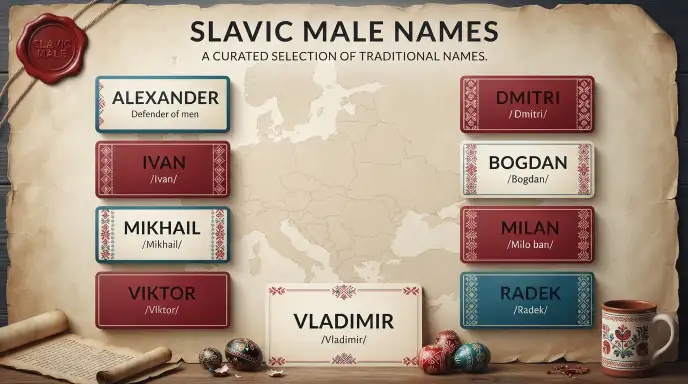
Slavic male names come from a wide range of languages and cultures across Eastern, Central, and Southeastern Europe. They are found in traditions such as Russian, Ukrainian, Polish, Czech, Slovak, Serbian, Croatian, Bulgarian, and Slovenian naming.
Some names are very old and were formed from native Slavic words. Others came from Greek, Hebrew, Latin, and other languages and later became established in Slavic communities. This makes the category much broader than a simple list of “Russian names.”
If you are looking for Slavic male names for a baby, character, story, or another purpose, it helps to consider the name’s meaning, language, pronunciation, and cultural background.
1. What Are Slavic Male Names?
Slavic male names are masculine given names connected with Slavic languages and naming traditions.
Slavic languages are generally divided into three major groups:
- East Slavic: Russian, Ukrainian, and Belarusian
- West Slavic: Polish, Czech, Slovak, and related languages
- South Slavic: Bulgarian, Serbian, Croatian, Slovenian, Macedonian, and related languages
Because these groups developed separately, their naming traditions are not exactly the same.
For example, Miroslav can be found in several Slavic traditions, while other names have a much stronger connection to one particular language or region.
Traditional Slavic names also often contain meaningful elements. Two common elements are mir, associated with peace, and slav, associated with glory or fame.
2. Traditional Slavic Male Names
Traditional Slavic naming includes many names built from meaningful elements. Some were created as compound names, combining two ideas into one personal name.
Here are some examples:
| Name | Traditional association |
| Miroslav | Peace + glory |
| Jaroslav | Glory with an element traditionally linked to vigor or spring |
| Stanislav | Standing/establishing + glory |
| Vladislav | Rule/power + glory |
| Radoslav | Joy + glory |
| Svetoslav | Light/holy + glory |
| Branislav | Protection/defense + glory |
| Dobroslav | Goodness + glory |
| Dragomir | Dear/precious + peace |
| Velimir | Greatness + peace |
| Radomir | Joy + peace |
| Bogdan | Given by God |
These meanings are based on the historical elements found in the names. Exact interpretations can vary across languages and historical sources.
3. Old Slavic Male Names
Some of the oldest Slavic naming traditions used two part personal names. Each part could express a particular quality, hope, social value, or idea.
Historical examples include:
- Jaroslav
- Miroslav
- Vsevolod
- Mstislav
- Sviatopolk
- Volodimer
- Svyatoslav
These names appear in historical records and traditions associated with medieval Slavic societies.
The element slav is especially common. It is connected with the idea of glory or fame, which explains why it appears in many different traditional names.
Other elements, such as mir, also became productive parts of Slavic personal names.
4. Slavic Male Names With “Mir”
The element mir is one of the most recognizable parts of traditional Slavic names. It is commonly associated with peace, although its historical linguistic development is more complex.
Examples include:
Miroslav
Miroslav combines mir with slav. It is traditionally understood as expressing an idea related to peace and glory.
Dragomir
Dragomir combines mir with an element associated with something dear or precious.
Velimir
Velimir contains mir and an element associated with greatness.
Radomir
Radomir combines mir with an element associated with joy or gladness.
Dobromir
Dobromir contains elements associated with goodness and peace.
These names demonstrate how traditional Slavic naming could combine two positive concepts into one name.
5. Slavic Male Names With “Slav”
Another major name element is slav, which is traditionally associated with glory, fame, or praise.
Examples include:
- Miroslav
- Jaroslav
- Stanislav
- Vladislav
- Radoslav
- Svetoslav
- Branislav
- Dobroslav
- Borislav
The spelling can change from one language to another.
For example, Polish uses forms such as Stanisław and Władysław, while other Slavic languages use forms closer to Stanislav and Vladislav.
This is why it is useful to identify the language before deciding which spelling of a Slavic name is appropriate.
6. East Slavic Male Names
East Slavic naming traditions are associated mainly with Russian, Ukrainian, and Belarusian languages.
Examples include:
- Vladimir
- Yaroslav
- Svyatoslav
- Vsevolod
- Mstislav
- Sviatopolk
- Bogdan
- Volodimer
Some of these names have different spellings depending on the language and transliteration system.
For instance, Yaroslav and Jaroslav represent related forms of the same traditional name, while the spelling used in a particular context may reflect the original language.
7. West Slavic Male Names
West Slavic naming traditions include Polish, Czech, and Slovak names.
Examples include:
- Mirosław
- Jarosław
- Stanisław
- Władysław
- Bolesław
- Bronisław
- Bohumil
- Dobromil
Polish spelling can look quite different from English forms because Polish has its own pronunciation and orthographic rules.
For example, Stanisław is related to the broader Slavic form Stanislav.
The difference does not necessarily indicate a completely different name. It can reflect the normal development of related forms within different Slavic languages.
8. South Slavic Male Names
South Slavic naming traditions include names found in Serbian, Croatian, Bulgarian, Slovenian, and Macedonian communities. Many traditional names in this group are built from old Slavic elements and have related forms in other Slavic languages.
Some examples include:
- Miroslav
- Branimir
- Dragomir
- Radoslav
- Tomislav
- Borislav
- Svetozar
- Zdravko
- Slavko
- Velimir
The same name may appear in more than one South Slavic language. However, its spelling, pronunciation, and modern use can differ by country.
For example, Tomislav has a strong South Slavic historical and cultural connection, while Miroslav and Radoslav are found across several Slavic naming traditions.
9. Strong Slavic Male Names
Many traditional Slavic male names have elements connected with ideas such as protection, rule, glory, courage, or battle.
Branimir
Branimir contains an element traditionally associated with defense or protection, along with mir, which is commonly associated with peace.
Vladislav
Vladislav combines an element associated with rule or power with slav, associated with glory or fame.
Stanislav
Stanislav contains an element related to standing or becoming established, together with slav.
Borislav
Borislav contains an element traditionally associated with fighting or battle, followed by slav.
Mstislav
Mstislav is an old Slavic personal name with a long historical record, particularly in East Slavic contexts.
A name can sound strong without literally meaning “strong.” Modern impressions and historical etymology are not always the same, so both should be considered separately.
10. Rare Slavic Male Names
Some traditional Slavic names may feel unusual to modern English speaking readers. They can be useful for people looking for distinctive names with historical or cultural connections.
Examples include:
- Vsevolod
- Mstislav
- Sviatopolk
- Velimir
- Dobromir
- Dragomir
- Branimir
- Svetozar
- Bohumil
- Boleslav
The word rare needs some care. A name that is uncommon internationally may still be familiar or well established in its original country.
For that reason, it is better to check a name’s use within a specific country, language, and time period before calling it rare.
11. Slavic Male Names Meaning Peace
The idea of peace appears frequently in traditional Slavic name formation. One of the most recognizable elements connected with this idea is mir.
Examples include:
- Miroslav
- Dragomir
- Velimir
- Radomir
- Dobromir
- Branimir
In traditional interpretations, mir is associated with peace. However, historical words can develop broader meanings, so translating an old name into one English word may not capture its complete linguistic history.
This is especially important when researching names from medieval Slavic sources.
12. Slavic Male Names Meaning Glory
The element slav is traditionally associated with glory, fame, or praise. It appears in many well known Slavic names.
Examples include:
- Miroslav
- Jaroslav
- Stanislav
- Vladislav
- Radoslav
- Svetoslav
- Branislav
- Borislav
- Dobroslav
This repeated element helps explain why many Slavic names have similar endings.
It also demonstrates an important feature of older Slavic naming traditions: meaningful elements could be combined to create names expressing different qualities or hopes.
13. Christian Names in Slavic Cultures
Not every male name used in a Slavic country is originally Slavic.
Christianity brought many names from Greek, Hebrew, Latin, and other languages into Slavic speaking communities. These names were often adapted to local pronunciation and spelling.
Examples include:
- Alexander
- Andrew
- Daniel
- George
- Michael
- Nicholas
- Peter
- Stephen
The forms of these names can vary across Slavic languages.
For example, a Christian name may have one established form in Russian, another in Polish, and another in Serbian. These local versions can become an important part of the naming tradition even when the original name is not Slavic.
So, a name used by Slavic people is not necessarily a name of Slavic origin.
14. How Slavic Male Names Differ by Language
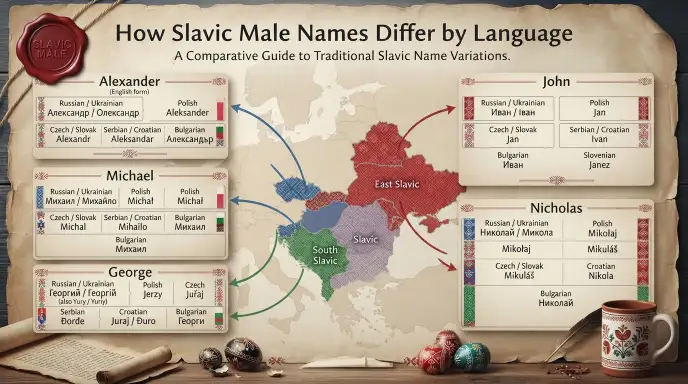
Related Slavic names can have noticeably different spellings in different languages.
For example:
- Stanislav → Stanisław
- Vladislav → Władysław
- Yaroslav → Jaroslav → Jarosław
- Miroslav → Mirosław
These differences can come from:
- Local spelling systems
- Pronunciation
- Historical sound changes
- Transliteration
- Grammar
- Regional naming customs
An English language spelling may also differ from the form normally written in the original language.
Therefore, if you are choosing a culturally specific name, it is useful to check the original language form rather than relying only on an English transliteration.
15. How to Choose a Slavic Male Name
A good way to choose a Slavic male name is to look at its language, meaning, history, and pronunciation.
1. Choose the Region
First decide if you want an East Slavic, West Slavic, or South Slavic name.
2. Check the Original Form
Look at how the name is actually written in its original language.
3. Research the Meaning
Check the historical elements that make up the name instead of relying only on simplified name list meanings.
4. Consider Pronunciation
A name may sound different in its original language than it does when pronounced in English.
5. Consider the Historical Period
Some names are still used today, while others are mainly found in medieval records, literature, or historical contexts.
6. Explore Regional Variants
A name may have several established forms across Slavic languages.
This approach can help you find a name that fits the specific cultural or linguistic setting you have in mind.
16. Quick List of Slavic Male Names
Here is a selection of names to explore:
- Miroslav
- Jaroslav
- Stanislav
- Vladimir
- Vladislav
- Radoslav
- Svetoslav
- Branimir
- Dragomir
- Dobromir
- Velimir
- Radomir
- Borislav
- Branislav
- Tomislav
- Sviatopolk
- Vsevolod
- Mstislav
- Svyatoslav
- Bogdan
- Boleslav
- Svetozar
- Zdravko
- Slavko
- Bohumil
These names come from different Slavic regions and historical periods. Their meanings, pronunciation, spelling, and modern usage should therefore be checked individually.
17. FAQs About Slavic Male Names
1. What are some traditional Slavic male names?
Traditional examples include Miroslav, Jaroslav, Stanislav, Vladimir, Radoslav, Branimir, and Vladislav.
2. What Slavic male names mean peace?
Names containing the mir element include Miroslav, Dragomir, Velimir, Radomir, and Dobromir. The element is traditionally associated with peace.
3. What Slavic male names mean glory?
Names containing slav, such as Miroslav, Jaroslav, Stanislav, Radoslav, and Vladislav, are traditionally associated with glory or fame.
4. What are some rare Slavic male names?
Examples include Vsevolod, Mstislav, Sviatopolk, Velimir, Dobromir, and Svetozar. if a name is rare depends on its country and historical period.
5. Are Russian names Slavic?
Yes. Russian belongs to the East Slavic branch of the Slavic language family.
6. Are Polish names Slavic?
Yes. Polish is a West Slavic language, and many traditional Polish names have Slavic origins or belong to broader Slavic naming traditions.
7. Are all names used in Slavic countries originally Slavic?
No. Slavic communities also use names with Greek, Hebrew, Latin, and other origins, especially names that became established through Christianity.
8. What is an old Slavic male name?
Historical examples include Sviatopolk, Vsevolod, Mstislav, Volodimer, and Svyatoslav. Some remain in use, while others are mainly associated with historical sources.
18. Final Thoughts
Slavic male names reflect a rich and varied linguistic history. Traditional names were often built from meaningful elements connected with ideas such as peace, glory, goodness, protection, joy, and rule.
At the same time, Slavic naming traditions also include names that came from other languages and became established through religious and cultural contact. This is why it is important to distinguish between a name used in a Slavic culture and a name that has Slavic etymological origins.
If you are choosing a Slavic male name, start with the specific language or region you want to represent. Then check its original spelling, pronunciation, meaning, and historical context.
This gives you a better understanding of not only what the name sounds like, but also where it comes from and how it fits into Slavic naming traditions.
Discover unique names!

Hi, I’m Emily Broks, a name researcher and content writer. I enjoy exploring unique baby names, meaningful names, pet names, cultural names, and creative name ideas to help readers find the perfect name.