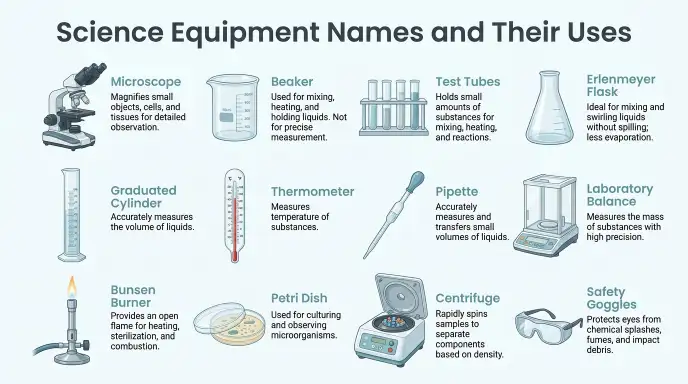
Science equipment includes the tools and instruments used to perform experiments, observe materials, and measure different properties. Common science equipment names include microscopes, beakers, test tubes, thermometers, pipettes, and laboratory balances. Each tool serves a specific purpose in scientific work.
Different branches of science use different types of equipment. Chemistry laboratories need tools for mixing and heating substances, while biology laboratories use microscopes to examine cells and specimens. Physics laboratories often use instruments to measure force, electricity, temperature, and motion.
Learning the names and uses of science equipment helps students understand experiments and recognize the right tools for different tasks. This guide covers common laboratory tools, measuring instruments, biology and physics equipment, advanced scientific instruments, and essential safety equipment.
Common Science Equipment Names
Laboratories use different tools for experiments, measurements, and observations. Some tools hold liquids, while others measure temperature, examine samples, or help scientists handle materials safely.
| Equipment Name | Main Use |
| Beaker | Holds, mixes, and heats liquids |
| Test tube | Holds small samples for experiments |
| Erlenmeyer flask | Mixes liquids and reduces splashing |
| Graduated cylinder | Measures liquid volume |
| Funnel | Transfers liquids into narrow containers |
| Glass stirring rod | Mixes liquids |
| Watch glass | Holds small samples or covers a beaker |
| Dropper | Transfers small amounts of liquid |
| Pipette | Measures or transfers liquid |
| Laboratory spatula | Transfers small amounts of solid chemicals |
The exact equipment used depends on the experiment. For example, a beaker works well for mixing liquids, but a graduated cylinder usually provides a more accurate volume measurement.
Measuring Science Equipment
Scientists use measuring instruments to collect reliable data. These tools help measure mass, temperature, volume, acidity, and other properties.
| Equipment Name | What It Measures |
| Thermometer | Temperature |
| Electronic balance | Mass |
| Analytical balance | Mass with high precision |
| Stopwatch | Elapsed time |
| pH meter | Acidity or alkalinity |
| Graduated cylinder | Liquid volume |
| Measuring pipette | Liquid volume |
| Burette | Delivers measured liquid volumes |
| Ruler | Length |
| Vernier caliper | Internal, external, and depth dimensions |
A thermometer helps track temperature changes during an experiment. An electronic balance measures the mass of a sample, while a pH meter checks how acidic or alkaline a solution is.
Choosing the correct measuring instrument matters. The required precision and the type of measurement determine which tool is most suitable.
Heating and Mixing Equipment
Many science experiments require controlled heat or thorough mixing. The equipment depends on the substance, temperature, and method used.
| Equipment Name | Main Use |
| Bunsen burner | Produces a flame for heating suitable materials |
| Hot plate | Heats samples without an open flame |
| Water bath | Provides gentle, controlled heating |
| Magnetic stirrer | Mixes liquids using a rotating magnetic bar |
| Tripod stand | Supports containers during heating |
| Wire gauze | Supports glassware and helps spread heat |
| Crucible | Holds materials for high,temperature heating |
| Evaporating dish | Helps evaporate liquid from a solution |
| Heating mantle | Heats compatible laboratory flasks |
| Incubator | Maintains controlled conditions for growing biological cultures |
A hot plate can be useful when an open flame is unsuitable. A water bath provides gentler heating, while a crucible can withstand temperatures that ordinary glassware cannot. Always follow the equipment’s operating instructions and laboratory safety rules.
Biology and Observation Equipment
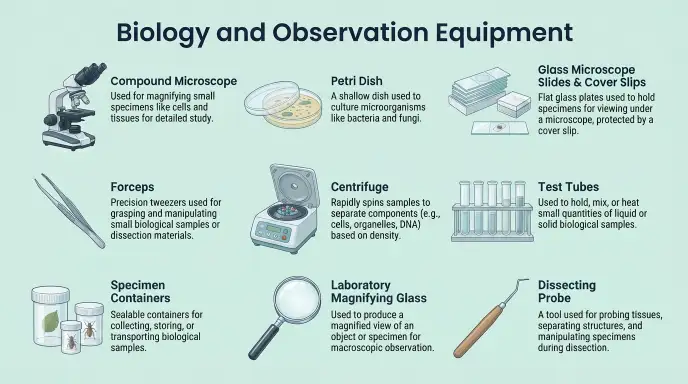
Biology laboratories use tools to examine cells, handle specimens, and study living systems. These instruments help researchers observe structures that the naked eye cannot easily see.
Microscope
Magnifies small specimens, such as cells and microorganisms, for detailed observation.
Petri Dish
Holds samples or suitable growth media for observing and studying microorganisms under approved laboratory conditions.
Microscope Slides and Cover Slips
Hold and cover specimens for viewing under a microscope.
Forceps
Hold and transfer small objects or specimens without direct hand contact.
Centrifuge
Separates sample components by spinning them rapidly. The separation depends on factors such as particle size and density.
Physics Laboratory Equipment Names
Physics experiments often involve motion, force, electricity, magnetism, light, and heat. The following tools help students observe these properties and record measurements.
| Equipment Name | Main Use |
| Ammeter | Measures electric current |
| Voltmeter | Measures electrical potential difference |
| Galvanometer | Detects small electric currents |
| Rheostat | Varies electrical resistance |
| Bar magnet | Demonstrates magnetic effects |
| Compass | Shows direction relative to a magnetic field |
| Meter scale | Measures length |
| Vernier caliper | Measures dimensions with greater precision |
| Screw gauge | Measures very small dimensions |
| Spring balance | Measures force using a spring |
| Stopwatch | Measures elapsed time |
| Pendulum apparatus | Studies oscillation and periodic motion |
| Calorimeter | Measures heat transferred during a process |
For example, an ammeter measures current and is connected in series in a typical circuit. A voltmeter measures the potential difference between two points and is connected in parallel. Correct connections help protect the instruments and produce useful results.
Advanced Scientific Instruments
Universities, research centers, medical laboratories, and industrial facilities often use specialized instruments. These tools analyze samples, control conditions, or perform tasks that basic school equipment cannot handle.
| Equipment Name | Main Use |
| Spectrophotometer | Measures light absorbed or transmitted by a sample |
| Autoclave | Uses pressurized steam to sterilize suitable materials |
| Fume hood | Helps control exposure to hazardous chemical vapors |
| Biological safety cabinet | Provides specified protection for personnel, samples, or the environment, depending on its class |
| Chromatography system | Separates mixture components for analysis |
| Mass spectrometer | Measures mass,to,charge ratios of ions |
| Conductivity meter | Measures a solution’s electrical conductivity |
| Water purification system | Produces water of a specified purity |
| Vacuum pump | Creates reduced pressure for compatible procedures |
| Analytical balance | Measures small masses with high precision |
| PCR thermal cycler | Repeatedly changes sample temperature for DNA amplification |
| Gel electrophoresis apparatus | Separates DNA, RNA, or proteins according to the method used |
Not every laboratory needs advanced instruments. The equipment selection depends on the field of research, sample type, required accuracy, budget, and safety requirements.
Laboratory Safety Equipment Names
Safety equipment helps reduce exposure to hazardous substances, heat, splashes, and other laboratory risks. Its correct use is an essential part of scientific work.
| Safety Equipment | Purpose |
| Safety goggles | Protect the eyes from splashes and particles |
| Lab coat | Protects clothing and helps limit contamination |
| Protective gloves | Protect hands from specific hazards when suitable |
| Face shield | Provides additional face protection against certain hazards |
| Fume hood | Controls hazardous chemical vapors |
| Eyewash station | Flushes the eyes during an exposure emergency |
| Safety shower | Provides emergency rinsing after certain exposures |
| Fire extinguisher | Controls suitable fires when use is safe and appropriate |
| First,aid kit | Supplies basic first,aid materials |
| Sharps container | Collects designated sharp or puncturing waste |
Safety equipment must match the hazard. Ordinary gloves do not protect against every chemical, and a fume hood is not a substitute for a biological safety cabinet. Laboratories should provide appropriate training and follow established emergency procedures.
How to Choose the Right Science Equipment
Choosing laboratory equipment starts with the task. A tool that works well for one experiment may be unsuitable for another.
- For measuring liquids: Use a graduated cylinder for routine volume measurements, a volumetric pipette for transferring a specified volume, or a burette for controlled delivery during titration.
- For observing tiny objects: Use a microscope suited to the specimen and the level of detail required.
- For measuring mass: Choose a balance with sufficient capacity and resolution for the sample.
- For heating materials: Select a suitable hot plate, burner, water bath, or other heating device based on the material and its hazards.
- For separating mixtures: Consider filtration, centrifugation, or chromatography according to the properties of the mixture.
- For protecting laboratory workers: Identify the hazards first, then choose the required protective equipment and engineering controls.
Remember that precision and accuracy are not the same. Precision describes how closely repeated measurements agree, while accuracy describes how close a measurement is to the accepted value.
Frequently Asked Questions
1. What are the most common science equipment names?
Common examples include beakers, test tubes, flasks, funnels, pipettes, graduated cylinders, thermometers, balances, microscopes, and safety goggles.
2. What equipment is used in a chemistry laboratory?
Chemistry laboratories commonly use beakers, flasks, test tubes, pipettes, burettes, funnels, balances, thermometers, and suitable heating equipment.
3. What equipment is used in a biology laboratory?
Typical biology equipment includes microscopes, slides, cover slips, Petri dishes, forceps, centrifuges, incubators, and other tools suited to the work.
4. Which science equipment measures temperature?
A laboratory thermometer or digital temperature probe measures temperature. The best choice depends on the required range, accuracy, and experiment.
5. What is the difference between a beaker and a graduated cylinder?
A beaker mainly holds, mixes, and heats liquids. A graduated cylinder measures liquid volume more accurately than a typical beaker.
6. What is the difference between a pipette and a burette?
A pipette transfers a measured quantity of liquid. A burette delivers controlled volumes, often during titration, and allows the delivered amount to be read from its graduations.
7. Why is laboratory safety equipment important?
It helps reduce the risk of injury, chemical exposure, contamination, and other hazards. Correct equipment, training, and safe procedures work together to protect laboratory users.
Final Thoughts
Science equipment names become easier to understand when the tools are grouped by purpose. Beakers and flasks hold liquids, balances and thermometers measure properties, microscopes reveal small structures, and specialized instruments analyze samples.
Learning each tool’s name and function helps students understand experiments and choose suitable equipment. Always consider the task, required precision, material compatibility, and safety instructions before using any scientific instrument.
Read more names!

Hi, I’m Emily Broks, a name researcher and content writer. I enjoy exploring unique baby names, meaningful names, pet names, cultural names, and creative name ideas to help readers find the perfect name.