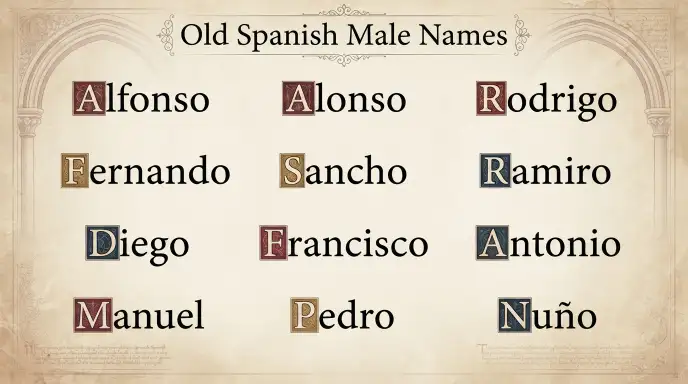
Old Spanish male names reflect centuries of history, culture, and tradition. Names such as Alonso, Rodrigo, Fernando, Sancho, and Alfonso bring to mind medieval Spain, while Antonio, Manuel, Francisco, and Ramón represent classic names passed down through generations.
if you are choosing a baby boy’s name, creating a historical character, or exploring Spanish heritage, these traditional names offer many styles to consider. Some have royal associations, others come from religious traditions, and many have roots in Latin or Germanic languages.
This guide explores old Spanish names for males, including classic favorites, medieval choices, rare historical names, and traditional names with meaningful origins.
Classic Old Spanish Male Names
Classic Spanish male names have remained familiar across generations. Many are still used in Spain and other Spanish-speaking countries today.
| Name | Meaning or Origin |
| Antonio | From the Roman family name Antonius; its original meaning is uncertain |
| Francisco | Spanish form of Francis, associated with a Frenchman |
| Manuel | Spanish form of Emmanuel, meaning “God is with us” |
| José | Spanish form of Joseph, traditionally interpreted as “he will add” |
| Juan | Spanish form of John, meaning “God is gracious” |
| Miguel | Spanish form of Michael, meaning “Who is like God?” |
| Pedro | Spanish form of Peter, meaning “rock” |
| Ramón | Spanish form of Raymond, commonly interpreted as “wise protector” |
| Fernando | A Germanic-derived name with several proposed interpretations |
| Rodrigo | Commonly interpreted as “famous ruler” |
| Tomás | Spanish form of Thomas, meaning “twin” |
| Vicente | Derived from a Latin name meaning “conquering” or “prevailing” |
| Andrés | Spanish form of Andrew, meaning “manly” |
| Martín | Spanish form of Martin, associated with Mars |
| Rafael | Spanish form of Raphael, meaning “God has healed” |
These names suit families who prefer a traditional Spanish style. Their origins vary, so a name’s long history in Spain does not necessarily mean it originated in the Spanish language.
Old-Fashioned Spanish Boy Names
Old-fashioned names often have a warm, familiar sound. Many were common in earlier generations and remain recognizable today.
Traditional Names With Vintage Charm
- Agustín : Spanish form of Augustine, derived from a Latin name.
- Alfredo : Spanish form of Alfred.
- Benito : Spanish form of Benedict, meaning “blessed.”
- Cayetano : A traditional Spanish given name associated with the Italian name Gaetano.
- Emilio : Spanish form of the Roman name Aemilius.
- Enrique : Spanish form of Henry, commonly interpreted as “home ruler.”
- Esteban : Spanish form of Stephen, meaning “crown” or “wreath.”
- Federico : Spanish form of Frederick, commonly interpreted as “peaceful ruler.”
- Gerardo : Spanish form of Gerard, associated with a spear and strength.
- Ignacio : Spanish form of Ignatius; its deeper origin is uncertain.
- Mariano : A traditional name derived from the Latin name Marianus.
- Salvador : Spanish for “savior.”
- Teodoro : Spanish form of Theodore, meaning “gift of God.”
- Leopoldo : Spanish form of Leopold, a name of Germanic origin.
- Arturo : Spanish form of Arthur, whose ultimate origin remains uncertain.
These names offer a vintage feel without requiring an unusual spelling. They can also work well for fictional characters who need a believable traditional Spanish name.
Medieval Spanish Male Names
Medieval Spanish names are useful for historical fiction, fantasy stories, and anyone interested in the history of the Iberian Peninsula. Some are linked to rulers and noble families, while others appear in older regional naming traditions.
| Name | Historical Background |
| Alfonso | A traditional name used by numerous Iberian kings |
| Alonso | A historical Spanish form related to Alfonso |
| Álvaro | An old Spanish name of Germanic origin |
| Gonzalo | A traditional name with Germanic roots |
| Nuño | A distinctive name found in medieval Spanish history |
| Sancho | A historic name associated with medieval Iberian rulers |
| Lope | A traditional Spanish name historically connected with Latin lupus, meaning “wolf” |
| Ramiro | A traditional name used by medieval Iberian rulers |
| Pelayo | Associated with early medieval Asturian history |
| Ordoño | A historic royal name associated with the Kingdom of León |
| Bermudo | An old Iberian royal name with Germanic roots |
| Froilán | A traditional Spanish name of Germanic origin |
| Rodrigo | A historic name associated with medieval rulers and warriors |
| Suero | A medieval Spanish name with an uncertain deeper origin |
| Ximeno | An older Spanish or Basque-associated form with a debated etymology |
Historical spellings can vary between records and periods. If you are naming a character from a particular century, check the form used in that time and region rather than assuming every old name was used throughout Spain.
Strong and Noble Old Spanish Male Names
Some traditional Spanish names carry associations with kings, military leaders, and historical figures. Their long use can give them a formal or dignified impression.
Names With Royal Associations
- Alfonso : Used by numerous kings across the Iberian Peninsula.
- Fernando : Associated with several Spanish monarchs.
- Felipe : Spanish form of Philip, traditionally interpreted as “lover of horses.”
- Carlos : Spanish form of Charles, traditionally associated with “free man.”
- Jaime : Spanish form of James, associated with the kings of Aragon.
- Enrique : A traditional royal name in Spain and other European countries.
- Pedro : Used by historical rulers in several Iberian kingdoms.
- Sancho : Associated with medieval kings of Navarre and Castile.
- Ramiro : Found among medieval rulers of León and Aragon.
- Rodrigo : A name associated with rulers and the medieval figure Rodrigo Díaz de Vivar.
These names can suit a historical character, a family seeking a classic name, or anyone who appreciates names with a strong historical presence. Their royal associations do not mean that only nobles used them.
Rare and Unusual Old Spanish Male Names
Some historical names are less familiar than Juan, José, or Antonio. They offer distinctive choices for people who want a stronger connection to medieval Iberian history.
Garsea
Garsea is a medieval name recorded in historical sources. Its exact origin is uncertain, although proposed explanations sometimes connect it with Basque naming traditions. It is an unusual choice for a character set in medieval Iberia.
Nuño
Nuño is a traditional medieval Spanish name. Its short form makes it easy to distinguish from longer names, while its historical associations give it an old-fashioned character.
Ordoño
Ordoño is associated with medieval rulers of León. Its distinctive sound makes it a strong option for historical fiction or someone researching early Iberian names.
Bermudo
Bermudo is an old royal name found in the history of the Iberian Peninsula. It has a distinctly historical feel and is less familiar than many modern Spanish names.
Suero
Suero appears in medieval Spanish naming traditions. Its deeper etymology is not fully settled, so it is best chosen for its historical use rather than an overly certain claimed meaning.
Pelayo
Pelayo is associated with early medieval Asturias and remains recognizable in Spain. It provides a historical alternative to more widely used Spanish names.
Froilán
Froilán is a traditional name of Germanic origin used in Spanish-speaking contexts. Its unusual sound can make it stand out among familiar classics.
Ximeno
Ximeno is an older form associated with Spanish and Basque naming history. Its precise origin is debated, which makes careful historical context especially useful.
Rare names do not always have rare meanings. Sometimes their appeal comes from their age, regional history, spelling, or association with a particular period.
Religious and Saint-Associated Spanish Male Names
Religious traditions have shaped Spanish naming practices for centuries. Many traditional male names come from biblical figures, saints, or Latin forms used in Christian communities.
| Name | Meaning or Association |
| José | Biblical name traditionally interpreted as “he will add” |
| Juan | Spanish form of John |
| Miguel | Name of the archangel Michael |
| Gabriel | Traditionally interpreted as “God is my strength” |
| Rafael | Traditionally interpreted as “God has healed” |
| Francisco | Associated with Saint Francis of Assisi |
| Antonio | Associated with several saints, including Saint Anthony of Padua |
| Pablo | Spanish form of Paul, traditionally associated with “small” |
| Pedro | Associated with Saint Peter |
| Domingo | Derived from Latin Dominicus, meaning “of the Lord” |
| Salvador | Spanish word for “savior” |
| Esteban | Spanish form of Stephen, associated with Saint Stephen |
Religious meaning, historical use, and personal belief are separate aspects of a name. A family may choose one for its cultural tradition, sound, family connection, or religious significance.
Old Spanish Male Names With Latin Roots
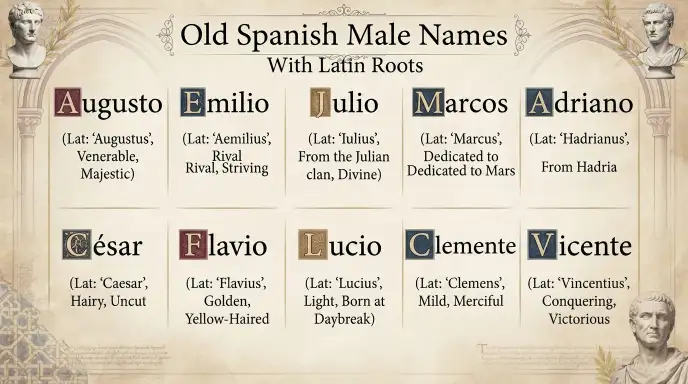
Latin influenced Spanish through the development of the Spanish language and the long history of Roman culture in the Iberian Peninsula. Some traditional names come directly from Latin words, while others developed from ancient Roman personal or family names.
- Augusto : From Latin Augustus, associated with honor and majesty.
- Clemente : From Latin Clemens, meaning “merciful” or “gentle.”
- Emilio : From the Roman family name Aemilius.
- Julio : Spanish form of Julius, an ancient Roman family name.
- Marcos : Spanish form of Marcus, traditionally associated with Mars.
- Adriano : Spanish form of Hadrianus, associated with the ancient place-name Hadria.
- Vicente : From a Latin name related to prevailing or conquering.
- César : From the Roman family name Caesar.
- Flavio : From Latin Flavius, associated with the meaning “golden” or “yellow-haired.”
- Lucio : Spanish form of Lucius, traditionally connected with the Latin word for light.
Researchers do not always know the exact origins of ancient Roman names. Where scholars disagree, it is better to describe a meaning as traditional or proposed rather than present it as certain.
How to Choose an Old Spanish Male Name
Choosing an old Spanish name is easier when you consider the name’s sound, history, and intended use.
Consider the Historical Period
For a medieval character, names such as Alfonso, Sancho, Ramiro, and Ordoño may fit the setting. For a character from a more recent generation, Antonio, Manuel, Ramón, or Francisco may feel more appropriate.
Check the Meaning
Some names have well-established meanings through their source languages. Others have uncertain or debated origins. Use a reliable explanation rather than choosing a name based on a dramatic but unsupported claim.
Think About Pronunciation
Spanish accents and spelling affect pronunciation. Names such as Agustín, Ramón, Álvaro, and Martín have written accents that help show where the stress belongs.
Consider Regional Identity
Castilian Spanish is not the only influence on Spanish naming traditions. Catalan, Galician, and Basque traditions also contribute to the wider naming history of Spain. A region-specific name can help make a historical character more believable.
Choose a Name That Fits Its Purpose
For a baby, ease of pronunciation and family preference may matter most. For a novel, game, or historical project, period accuracy and regional context may matter more.
Choose the best name based on how and where you plan to use it.
Frequently Asked Questions
What are some classic old Spanish male names?
Classic choices include Juan, Pedro, José, Antonio, Manuel, Francisco, Miguel, Ramón, Fernando, and Rodrigo. These names have long histories in Spanish-speaking communities.
What are some rare medieval Spanish male names?
Garsea, Nuño, Ordoño, Bermudo, Suero, Pelayo, and Froilán are distinctive historical options. Their documented use and exact origins vary.
Which old Spanish male names have royal connections?
Alfonso, Fernando, Jaime, Pedro, Sancho, Ramiro, and Enrique have associations with rulers in Spain and other Iberian kingdoms.
Are old Spanish names still used today?
Yes. Names such as Antonio, Francisco, Manuel, José, and Fernando remain recognizable today. Other historical names, including Ordoño and Bermudo, are much less common in everyday use.
What is the difference between an old Spanish name and a vintage Spanish name?
An old Spanish name may refer to a name documented centuries ago, including medieval forms. A vintage Spanish name usually refers to a traditional name associated with earlier generations, even if people still use it today.
Do all old Spanish male names come from Spanish?
No. Spanish naming traditions include names of Latin, Hebrew, Greek, Germanic, and regional origins. A name can be traditional in Spain without originating in the Spanish language.
Final Thoughts
Old Spanish male names offer a wide range of styles, from familiar classics such as Juan and Francisco to distinctive historical choices such as Nuño, Pelayo, and Ordoño. Their histories reflect the many languages, regions, and traditions that have shaped Spain.
When choosing a name, consider its documented history, pronunciation, meaning, and cultural context. A well-chosen traditional name can honor the past while still feeling suitable for the present.
Read unique names!

Hi, I’m Emily Broks, a name researcher and content writer. I enjoy exploring unique baby names, meaningful names, pet names, cultural names, and creative name ideas to help readers find the perfect name.